Running a household is a coordination problem. Here is how to make it easier.
Everybody knows something and nobody knows everything. The three things that actually make a household easier to run, and where to start.

In most households, everybody knows something and nobody knows everything. One of you knows the car tax is due this month. Someone else knows swimming moved to Thursday. Whoever did the last shop knows you are nearly out of the good coffee, and the person who took the call knows the dentist wants ringing back. All of it is known. None of it is in the same place.
That is the actual problem, and it is worth saying plainly because it is not the one most advice tries to solve. The information is not missing. It is scattered, held in different heads, on different phones, in different apps, and it only ever assembles when somebody stops and asks. Which is usually about four minutes before it matters.
Running a household is not really a to-do list. A to-do list is a nice flat thing you can finish. It is a coordination problem, which is a different and slipperier beast. It is not just the tasks. It is everyone having the same picture of what is coming, so that plans can be made without a briefing session, and nothing depends on one person happening to remember to mention it.
The good news is that most of this is solvable, and none of the solutions require anyone to become a more organised person. That is the trap. Most advice assumes the problem is a lack of discipline and prescribes more of it. It is not, and it does not help. The tools most families use were simply not built for how households actually work and the fix is picking ones that do the joining-up for you.
The three things that actually make a household easier to run
Strip it back and household coordination comes down to three jobs. Almost every specific problem is a version of one of these.
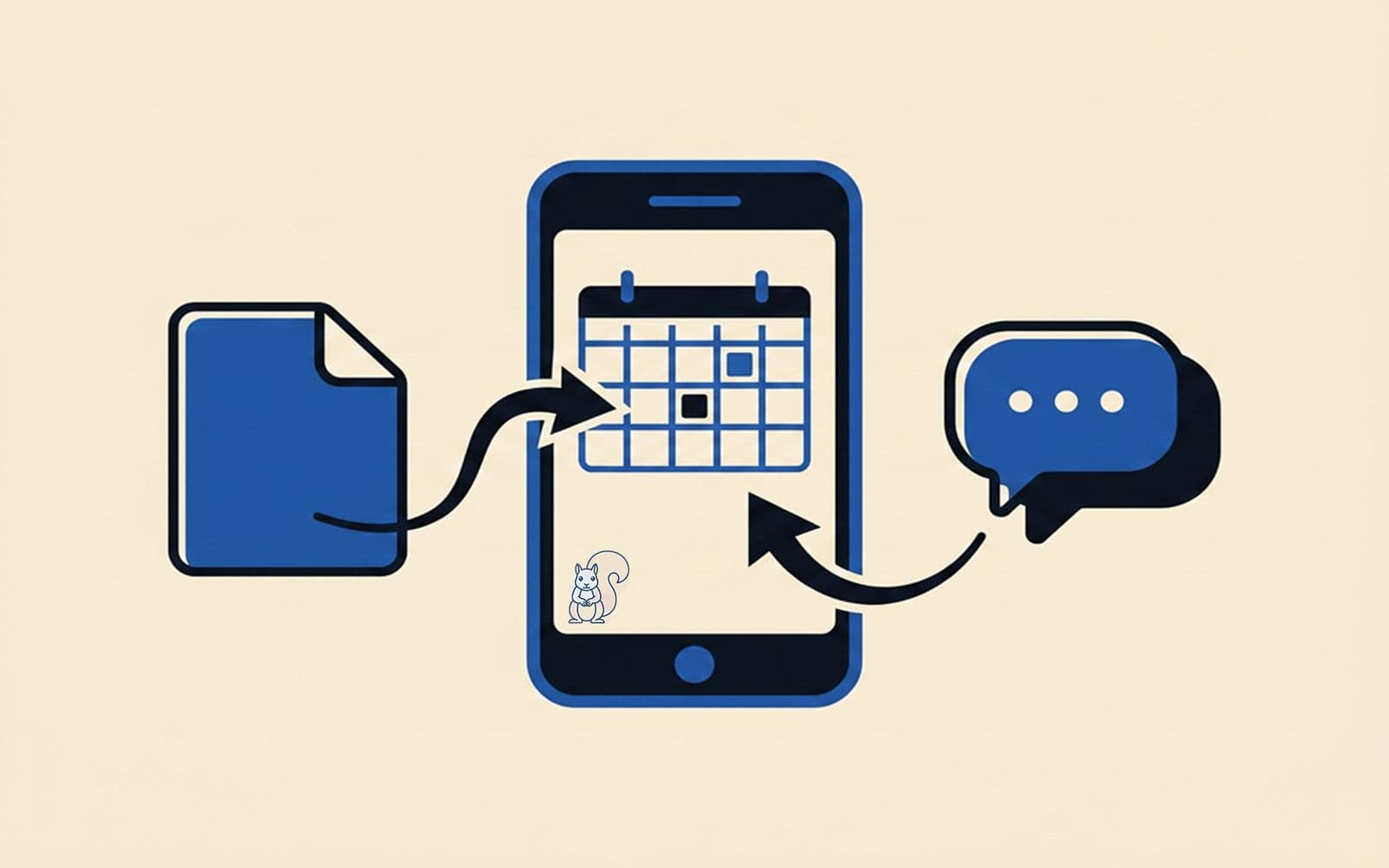
Everyone can see the same picture. The single biggest cause of “but you never told me” is not somebody failing to tell you. It is that the schedule lives in several places at once and no version is complete. The moment it lives somewhere everyone can see, most of that friction goes. This is what shared calendars are for, and we will get to the how, including the annoying reality that your family is probably split across iPhone and Android.
The things that have not happened yet get remembered somewhere other than in a head. Calendars are good at events with a time and a place. They are bad at the other 80 percent: the form that needs signing sometime this week, the prescription that needs reordering, the thing you thought of at 9pm that is not urgent but must not be lost. That is a reminders problem, not a calendar problem, and it is where most of the load actually lives.
Nothing depends on one person passing it on. Information held by one person and shared verbally is information waiting to be dropped, and no amount of good intentions fixes that. What works is a system where the knowing is shared automatically so a plan does not fall over because the one person who knew was on a train at the time.
Get those three right and the household runs itself a little more and lives in everyone’s heads a little less.
Why it is harder than it should be
A few things make this really difficult and it is worth naming them so the difficulty stops feeling like a personal failing.
Your family is on different devices. One of you on an iPhone, one on Android, a grandparent on whatever they were handed in a shop, a teenager on something else again. Most tools work beautifully inside one ecosystem and badly across them, which is precisely the situation every real family is in.
The information arrives in different places. School emails to one address, a WhatsApp from the club about kit, a letter in a bag, a text about a delivery window. It lands wherever it lands, with whoever happens to be holding the phone, and nothing gathers it up.
And the tools ask you to come to them. Another app to open, another login, another place to check. Keeping a system fed is its own small chore, and it is why so many promising Sunday-night systems are quietly dead by Wednesday.
The households that crack it are not more disciplined. They have stopped fighting these three facts and picked tools that bend around them instead.
Where to start
You do not fix all of this at once. Start with whatever is causing the most friction right now, and for most households that is simply everyone being able to see the same schedule.
This is the beginning of a series. Each piece takes one part of the coordination problem and shows you how to actually solve it.
• Sharing a calendar across everyone’s phones. Getting the whole household seeing the same schedule, even when you are split across iPhone and Android. The right place to begin.
• Reminders that are not calendar events. Catching the 80 percent a calendar misses and sharing it so it does not rely on anyone remembering to mention it.
• When the information is scattered. School emails, club messages, letters in bags, and how to get it all landing in one place everyone can see.
• Keeping an eye on things you cannot diarise. Prices, availability, statuses that change when they feel like it.
Each one stands on its own. Read whichever matches the thing driving you slightly mad this week.
The point of all of it is the same. What one of you knows, all of you should know, without anyone having to run the briefing. That is what a household that runs itself actually looks like, and it is considerably more achievable than another year of finding things out four minutes before they matter.
Baylo helps households share what they know through WhatsApp, whoever is on whatever phone. No new app to download. baylo.ai
By Sarah from BayloUseful tips
More to read
How to share a family calendar across everyone's phones (even iPhone and Android)
Most households do not have a scheduling problem, they have a visibility problem. Here is how to get everyone seeing the same schedule, whatever phone they are on.
 Sarah from Baylo4 min read

The best apps for family organisation in the UK (and why most of them require too much effort)
A guide to the best apps for family organisation in the UK — what each one is actually good for, who it's built for, and why most of them only work if you're already organised.
Sarah from Baylo9 min read